A Look Ahead

http://commons.wikimedia.org/wiki/File:The_Court_Of_Honor_%E2%80%94_Official_Views_Of_The_World%27s_Columbian_Exposition_%E2%80%94_15.jpg

On the occasion of the 1893 World’s Fair, the American Press Association asked 74 prominent Americans to imagine the United States of 1993. Some responses:

  • “By the 1990s, longevity will be so improved that 150 years will be no unusual age to reach.” — Thomas De Witt Talmage, Presbyterian preacher
  • “In the 1990s, the United States will be a government of perhaps 60 states, situated in both North and South America.” — Asa C. Matthews, comptroller of the Treasury
  • “Wealth will be more widely and equally distributed. Great corporations and business interests will be conducted harmoniously — on the principle of the employers and workers sharing in the profits.” — Junius Henri Browne, journalist
  • “Three hours will constitute a long day’s work.” — Mary E. Lease, activist and lecturer
  • “Trousers will be relegated to bookkeepers, barbers, pastry bakers, and cripples.” — Van Buren Denslow, attorney and economist
  • “We are going to see a wonderful development in the use of jewels in American churches.” — George F. Kunz, mineralogist
  • “By the end of the Twentieth Century, taxation will be reduced to a minimum, the entire world will be open to trade, and there will be no need of a standing army.” — Erastus Wiman, journalist

“Perhaps I am wrong in some of these prophecies,” reflected drama critic John Habberton, who had predicted that all marriages would be happy. “But if that is so, I shall not be here to be twitted with it — now will I?”

To Catch a Thief

http://www.google.com/patents/about?id=8zFOAAAAEBAJ

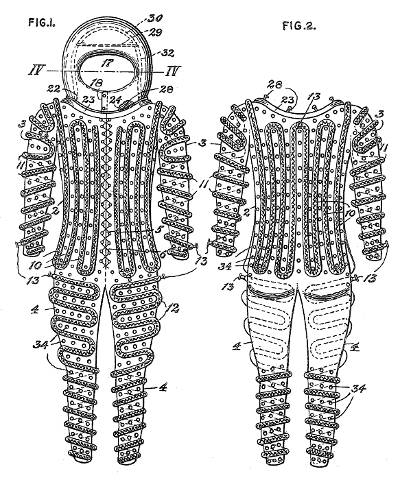
Early inventions to catch car thieves were positively quaint: Thomas Burghart’s 1921 “thief trap” would simply clutch the intruder’s leg and sound an alarm to alert the owner. “The person is thereby held to the seat and cannot get away.”

Yair Tanami’s solution, patented 68 years later, is less forgiving: It mounts a high-voltage discharge electrode under the seat. “In the arrangement illustrated in Figs. 2-5, bursts of high voltages of up to 60,000 volts peak have been produced which were found sufficient to temporarily immobilize the threatening person without permanently injuring him.”

http://www.google.com/patents/US4821017

News to Us

Unfortunate newspaper headlines collected by readers of the Columbia Journalism Review:

READER IS UPSET OVER DOG EATING FILIPINOS (The Wayne County Outlook, Monticello, Ky., Feb. 25, 1982)

MORE OF US WILL LIVE TO BE CENTURIONS (The Times Reporter, Dover-New Philadelphia, Ohio, Feb. 11, 1987)

POLICE BRUTALITY POSTPONED (The Mishawaka, Ind., Enterprise, Oct. 1, 1981)

DESPITE OUR BEST EFFORTS, BLACK EMPLOYMENT IS STILL RISING (The Evening Times, West Palm Beach, Fla., Oct. 3, 1980)

BRITISH LEFT WAFFLES ON FALKLANDS (Guardian, April 28, 1982)

FRIED CHICKEN COOKED IN MICROWAVE WINS TRIP (The Oregonian, July 8, 1981)

CROWDS RUSHING TO SEE POPE TRAMPLE 6 TO DEATH (Journal Star, Peoria, Ill., July 9, 1980)

HERE’S HOW YOU CAN LICK DOBERMAN’S LEG SORES (Reading Eagle, May 23, 1982)

EYE DROPS OFF SHELVES (Tri-City Herald, Pasco, Wash., Aug. 5, 1982)

PESTICIDE CONCERNS BLOSSOM (Williamsport, Pa., Sun-Gazette, May 21, 1985)

PRINCE ANDREW TAKES KOO PEASANT HUNTING IN SCOTLAND (The Atlanta Journal and Constitution, Nov. 28, 1982)

In February 1986 the Durham, N.C., Sun reported that contributions to Duke University’s Fuqua School of Business had increased by 120 percent in the previous year. It chose the headline FUQUA SCHOOL GIVING UP.

Command Performance

J.B.S. Haldane’s father was a physiologist who would sometimes take his son along while investigating mines in order to teach him the rudiments of science. At one point they were lowered by a bucket into a pit in North Staffordshire, where a tunnel’s low roof forced their party to crawl:

“After a while, we got to a place where the roof was about eight feet high and a man could stand up. One of the party lifted his safety lamp. It filled with blue flame and went out with a pop. If it had been a candle this would have started an explosion, and we should probably have been killed. But of course the flame of the explosion inside the safety lamp was kept in by the wire gauze. The air near the roof was full of methane, or firedamp, which is a gas lighter than air, so the air on the floor was not dangerous.

“To demonstrate the effects of breathing firedamp, my father told me to stand up and recite Mark Anthony’s speech from Shakespeare’s Julius Caesar, beginning ‘Friends, Romans, countrymen.’ I soon began to pant, and somewhere about ‘the noble Brutus’ my legs gave way and I collapsed on to the floor, where, of course, the air was all right. In this way I learnt that firedamp is lighter than air and not dangerous to breathe.”

Changing Colors

http://www.sxc.hu/photo/190748

Fifty-five chameleons live on a tropical island. Thirteen are green, 19 are brown, and 23 are gray. Whenever two chameleons of different colors meet, both change to the third color. Is it possible that all 55 chameleons might eventually be the same color?

Click for Answer

Unquote

http://commons.wikimedia.org/wiki/File:Richard_Neuhauss_Otto_Lilienthals_Flug_vom_29_Mai_1895.jpg

“Outside of the proven impossible, there probably can be found no better example of the speculative tendency carrying man to the verge of the chimerical than in his attempts to imitate the birds, or no field where so much inventive seed has been sown with so little return as in the attempts of man to fly successfully through the air. … It may be truly said that, so far as the hope of a commercial solution of the problem is concerned, man is to-day no nearer fulfillment than he was ages ago when he first dreamed of flying.” — Rear Admiral George W. Melville, engineer-in-chief, U.S. Navy, 1901

Express

http://commons.wikimedia.org/wiki/File:The_General,_front.jpg

Buster Keaton’s 1926 comedy The General is based on a real event. In April 1862 a group of Union volunteers hijacked a Confederate train in Georgia and led the rebels on an 88-mile, six-hour chase through the state, tearing up tracks and cutting telegraph lines as they went and releasing cars behind them to slow their pursuers. The conspirators ran out of fuel just short of Chattanooga, their goal, but the Union awarded a Medal of Honor to most of them for the exploit.

Keaton turned this into the story of Johnnie Gray, a hapless Georgia engineer who proves his mettle by chasing a stolen Confederate locomotive across Tennessee in order to rescue his beloved. The film’s central train chase is a masterpiece of mechanical slapstick, essentially a live-action cartoon showcasing the actor’s hair-raising stunts with locomotives, cannon, fire, and dynamite as the trains roll through the Southern countryside.

https://www.youtube.com/watch?v=Ytd7tKEvz2M

“I was more proud of that picture than any I ever made,” Keaton said in 1963. “Because I took an actual happening out of the … history books, and I told the story in detail, too.”

So It Goes

The Man who thought about Proteids sat by the roadside, writing with an indelible pencil in a little notebook. And Spring, all in pink and white, came tripping by, and cried to him: ‘I will dance for you! Watch me dance!’ She danced very prettily, but the Man went on writing, and never looked at her once. So Spring, being young, burst into tears, and told her sister, Summer.

Summer said to herself: ‘Spring is very foolish to cry. Probably he does not like dancing. I will sing to him.’ She sang a beautiful sleepy song to him, but he never listened, being busy writing in his little notebook. Summer was indignant, and told her sister, Autumn.

Autumn said: ‘There are many good men who do not like dancing. I will give him some of my wine.’ So she went to the Man and offered him her purple wine, but he merely said, ‘I do not drink wine,’ and resumed his writing. Then Autumn was very angry indeed, and told her big brother, Winter, all that had passed.

Winter was an enormous fellow, with a dreadful roar and howl, and every time he moved, snowflakes came whirling from his flowing robes. ‘Show me the fellow,’ he bellowed, puffing out his cheeks. Then he saw the Man who thought about Proteids, still sitting by the roadside.

‘Do you know me?’ roared Winter, and the Man looked and his teeth chattered like dead men’s bones.

Then Winter seized him by the neck and whirled him round and round, and finally flung him over his left shoulder into space.

And the Man who thought about Proteids has not been seen since, but, the other day, a boy found the little note-book lying by the roadside.

— J.B. Priestley, Brief Diversions, 1922