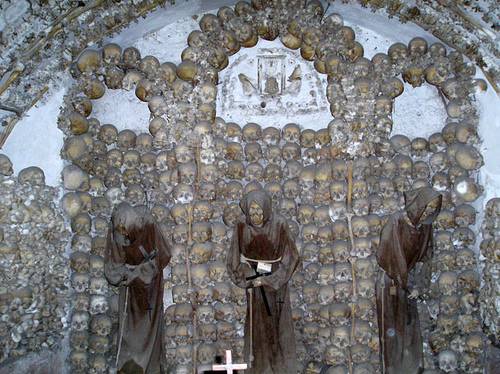
Rome’s Capuchin Crypt contains the remains of more than 4,000 monks who died between 1528 and 1870, including several intact skeletons wearing Franciscan habits.
Reportedly it inspired the Sedlec Ossuary.

Rome’s Capuchin Crypt contains the remains of more than 4,000 monks who died between 1528 and 1870, including several intact skeletons wearing Franciscan habits.
Reportedly it inspired the Sedlec Ossuary.

Drowning victims:
Canadians John and Jackie Knill were vacationing in Thailand when the 2004 Indian Ocean tsunami struck, killing both. A missionary later found their camera, which showed the wave approaching until it was nearly upon them.

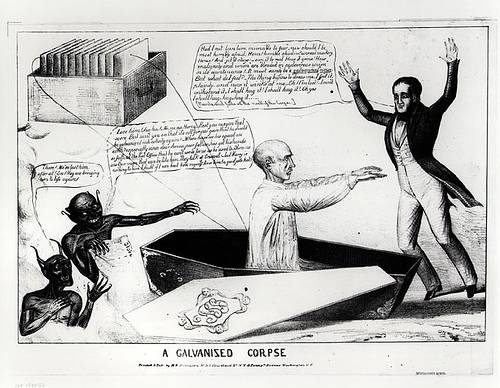
Frankenstein nearly came true in 1803, when Italian physicist Giovanni Aldini ran electric current through the newly dead body of murderer George Forster.
The prison record states that “on the first application of the process to the face, the jaws of the deceased criminal began to quiver, and the adjoining muscles were horribly contorted, and one eye was actually opened. In the subsequent part of the process the right hand was raised and clenched, and the legs and thighs were set in motion.”
One witness reportedly died of fright, but there was really no cause for alarm. If Forster had returned to life, the prison planned to re-execute him — after all, he’d been sentenced to “hang until he be dead.”

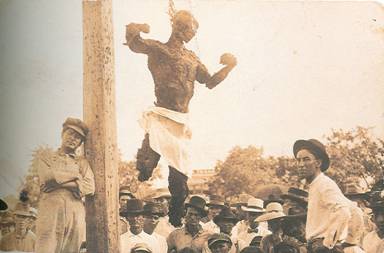
Between 1882 and 1930, Texans committed 492 lynchings. By most accounts, the most horrible of these was the 1916 slaying of Jesse Washington, a Waco farmhand who had confessed to the rape and murder of a white farmer’s wife.
A jury of 12 whites deliberated for four minutes before declaring Washington guilty. They called for the death penalty, but before authorities could act, he was dragged from the courtroom, doused with coal oil, and suspended alive over a bonfire. A witness wrote:
Washington was beaten with shovels and bricks … was castrated, and his ears were cut off. A tree supported the iron chain that lifted him above the fire. … Wailing, the boy attempted to climb up the skillet hot chain. For this, the men cut off his fingers.
Washington’s corpse was put in a cloth bag and dragged behind a car to Robinson, where it was hung from a pole. Northern newspapers condemned the lynching, but Texas was largely unrepentant. The image above is taken from a postcard (!); on the back someone has written, “This is the barbeque we had last night. My picture is to the left with a cross over it. Your son, Joe.”
Excerpt from the will of Joseph Dalby, London, 1784:
I give to my daughter Ann Spencer, a guinea for a ring, or any other bauble she may like better: — I give to the lout, her husband, one penny, to buy him a lark-whistle; I also give to her said husband, of redoubtable memory, my fart-hole, for a covering for his lark-whistle, to prevent the abrasion of his lips; and this legacy I give him as a mark of my approbation of his prowess and nice honour, in drawing his sword on me, (at my own table), naked and unarmed as I was, and he well fortified with custard.
Ruth Sprague, Daughter of Gibson and Elizabeth Sprague.
Died June 11, 1846, aged 9 years, 4 months, and 3 days.
She was stolen from the grave by Roderick R. Clow, dissected
at Dr. P.M. Armstrong’s office, in Hoosick, N. Y., from which
place her mutilated remains were obtained and deposited here.
Her body dissected by fiendish man,
Her bones anatomized,
Her soul, we trust, has risen to God,
Where few physicians rise.
— Epitaph, Hoosick Falls, N.Y.

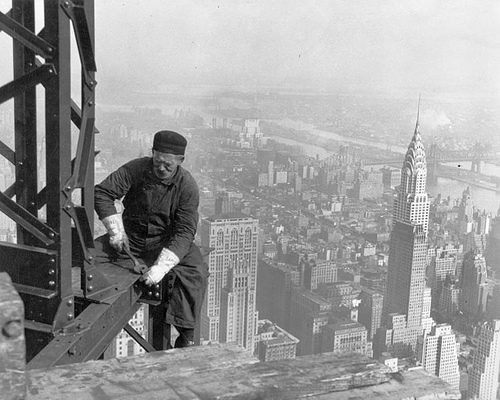
3,400 workers built the Empire State Building.
Five died.

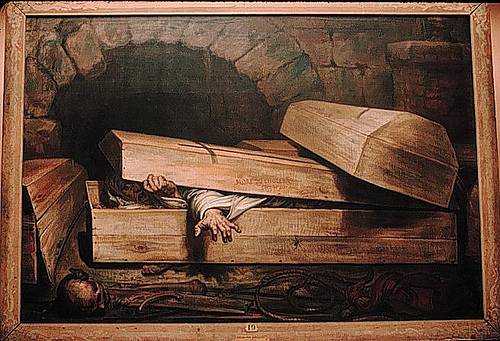
A soldier of the 93d regiment, quartered in the barracks, was looked upon to be dead, and after having been laid out in the usual way during two days, was conveyed to the place of interment (St. Nicholas’s churchyard) on yesterday evening, when, on lowering the body into the grave, the soldiers assisting heard the noise of struggling in the coffin, and on examination found the man whom they were in the act of burying, endeavouring with his hands and knees to force up the lid. To their great surprise they found their comrade still alive, and conveyed him home in the open coffin. This should prove an additional warning against premature interment.
— Courier, June 13, 1815
Pity Lal Bihari: In 1976 the Indian farmer applied for a bank loan and learned he was dead. His uncle had arranged it in order to get control of his land.
This is fairly common in the crowded northern state of Uttar Pradesh, and it creates an odd predicament: If you complain too much about being dead, your enemies might kill you for real.
The struggle led Bihari to make some strangely existential demonstrations. He added the word “dead” to his name, signed his letters as the “late” Lal Bihari, organized his own funeral, and demanded a widow’s compensation for his wife.
Finally he was recalled to life in 1994, after 18 years in the grave. But the “association of the dead” that he founded has now grown to 20,000 members.
One of the officers of Haslar Hospital being dangerously ill, a medical gentleman who was attending him, had occasion, about two o’clock on Saturday morning, the 25th of December, 1814, to send the nurse from the officer’s house to the dispensary; the weather being bad, the nurse wrapped herself round with a piece of red baize, with which she covered, in part, a candle and lantern, to prevent the light from being blown out, as the wind was very high. The rays of light issuing from the red covering, to the imagination of a sentry at a distance, she appeared a terrific spectre; and as she approached him his fear so increased, that he ran from his post with haste to the guard-house, where, in about half an hour, he expired!
— Courier, Dec. 28, 1814