
An optical illusion. Squares A and B are the same color.

An optical illusion. Squares A and B are the same color.
unnun
v. to strip a nun of her position or character
dispope
v. to depose from popedom
Van Helmont tells a story of a person who applied to Taliacotius to have his nose restored. This person, having a dread of an incision being made in his own arm, for the purpose of removing enough skin therefrom for a nose, induced a laborer, for a remuneration, to allow the skin for the nose to be taken from his arm. About thirteen months after the adscititious nose suddenly became cold and, after a few days, dropped off, in a state of putrefaction. The cause of this unexpected occurrence was investigated, when it was discovered that, at the same moment in which the nose grew cold, the laborer at Bologna expired.
— Frank H. Stauffer, The Queer, the Quaint and the Quizzical, 1882
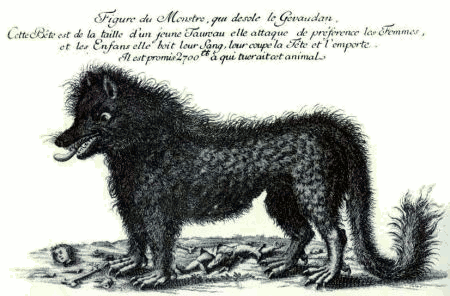
This is the Beast of Gévaudan, a wolf the size of a cow that terrorized southeastern France in the 18th century. All the big press in “cryptozoology” goes to Bigfoot, the Loch Ness Monster, and the Abominable Snowman, but there’s a cast of B players that are a lot more colorful:
My favorite, though, is the New Jersey Vegetable Monster: A single drunken witness claimed to have seen a humanoid resembling a giant stalk of broccoli in the New Jersey Pine Barrens. “Likely attributable to a case of delirium tremens.”
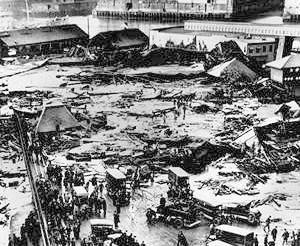
Of sweetness, Shakespeare wrote: “A little more than a little is by much too much.” Boston learned this the hard way in the Molasses Disaster of 1919, when someone tried to fill a weak tank with 2.3 million gallons of the thick syrup.
“A muffled roar burst suddenly upon the air,” wrote the Boston Herald. “Mingled with the roar was the clangor of steel against steel and the clash of rending wood.”
The tank collapsed, sending a giant wave of molasses sweeping through the North End. Even in the January cold, the wave would have been 8 to 15 feet high and traveled at 35 mph. It broke the girders of the elevated railway, lifted a train off its tracks, and tore a firehouse from its foundation. Twenty-one people stickily drowned, and 150 were injured. Cleanup took six months; one victim wasn’t found for 11 days.
No one knows the cause, but it’s been noted that molasses was used in making liquor, and the disaster occurred one day before Prohibition was ratified. It appears the owners were trying to distill molasses into grain alcohol before the market dried up. Write your own pun.
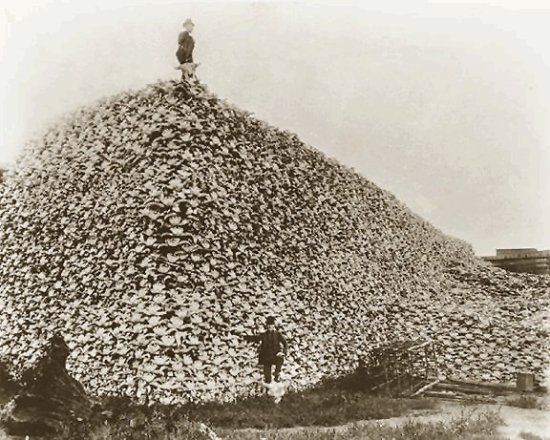
Those are bison skulls, in the 1870s, waiting to be ground into fertilizer. Before Columbus there were 60 million bison in North America; by 1890 there were 750. They were holding up our railroads. Now they’re back up to 350,000, but 70 percent of those are being raised for human consumption.
“God is a Republican, and Santa Claus is a Democrat.” — H.L. Mencken
Clearly there are integers so huge they can’t be described in fewer than 22 syllables. Put them all in a big pile and consider the smallest one. It’s “the smallest integer that can’t be described in fewer than 22 syllables.”
That phrase has 21 syllables.
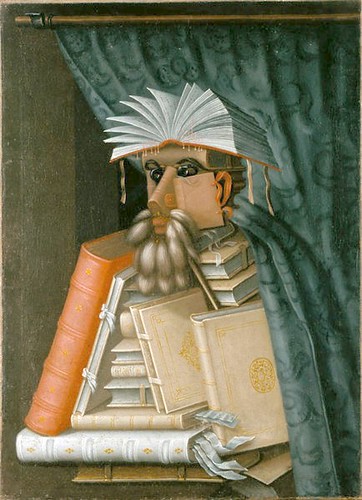
Giuseppe Arcimboldo‘s caricature of Rudolf II’s historiographer and librarian, Wolfgang Lazio (1514-1565) — a collector of coins and a lover of books.
84 + 24 + 04 + 84 = 8208